
Digital Asset Capitalisation & Equity Valuation
A practical institutional guide to digital real estate, organic domain authority compounding, balance-sheet capitalization models, and low-carrying-cost asset accumulation for UK operators.
The Shift from Hourly Labor to Asset Equity: Traditional online business advice usually pushes people into transactional gig work or client freelancing. While freelancing brings in immediate cash, it stops the moment you take time off. By contrast, digital asset capitalisation treats website domains, content repositories, and reference hubs as real property assets that grow in equity as search traffic compounds.
In the United Kingdom, structuring a digital asset correctly keeps your ongoing carrying costs under £35 a year, protects your personal time, and lets you use the statutory £1,000 HMRC Trading Allowance as a risk-free testing vehicle.
I. Core Valuation Mechanics of Digital Real Estate
Why digital property outclasses physical real estate in net capital efficiency, liquidity, and operational overhead.
Near-Zero Carrying Cost
Physical property requires mortgage payments, council rates, insurance, and maintenance. A digital web asset costs only £10 to £35 per year to maintain. This allows the asset to survive indefinitely during quiet periods without burning through personal capital.
Search Equity Compounding
Unlike machinery or vehicles that lose value through wear and tear, high-quality digital properties gain authority with age. Each verified inbound link and indexed article compounds your organic visibility in search results.
Time Independence
Cash flow generated through automated referral channels and downloadable digital materials operates around the clock. Because the system runs without manual fulfillment, your income is no longer tied to hourly work.
Standard Digital Asset Valuation Multiples
Well-structured UK digital informational properties with verified cash flows and clean tax records trade on standard brokerages at established monthly net profit multiples:
II. Comparative Capital Allocation Matrix
A direct audit comparing physical Buy-to-Let property deployment against digital asset capitalisation.
| Evaluation Parameter | Physical Commercial / Buy-to-Let | Digital Asset Holding (Pillar I) |
|---|---|---|
| Initial Capital Outlay | Substantial (£25,000 – £80,000+ deposit, stamp duty) | Minimal (< £50 domain, edge hosting, setup) |
| Annual Holding / Carrying Cost | High (Mortgage, rates, insurance, boiler certifications) | Negligible (£10–£35 annual registrar/hosting renewals) |
| Statutory Tax Exemption | None (Section 24 mortgage restrictions apply) | £1,000 Tax-Free Trading Allowance (ITTOIA 2005 s.23FA) |
| Dispute & Tenant Friction | High (Eviction processes, damage liabilities, repairs) | Zero (Pure digital reference and programmatic routing) |
| Scalability Potential | Linear (Constrained by geographic physical boundary) | Global (Edge servers serve 10,000+ simultaneous readers) |
III. Strategic Asset Capitalisation Roadmap
A structured three-stage protocol for developing a sellable digital property.
The Foundation Node
Acquire a clean, brandable UK or international domain. Publish foundational pillar content answering high-intent questions. Keep total startup costs under £50.
The £1,000 Safe Harbor
Integrate automated affiliate links and digital reference downloads. Earn up to the £1,000 statutory trading threshold completely tax-free while refining your conversion numbers.
Entity Capitalisation
When gross revenue crosses £1,000, register as a sole trader or incorporate an LTD under the Companies Act 2006. Your asset now qualifies as a distinct, sellable balance-sheet intellectual property.
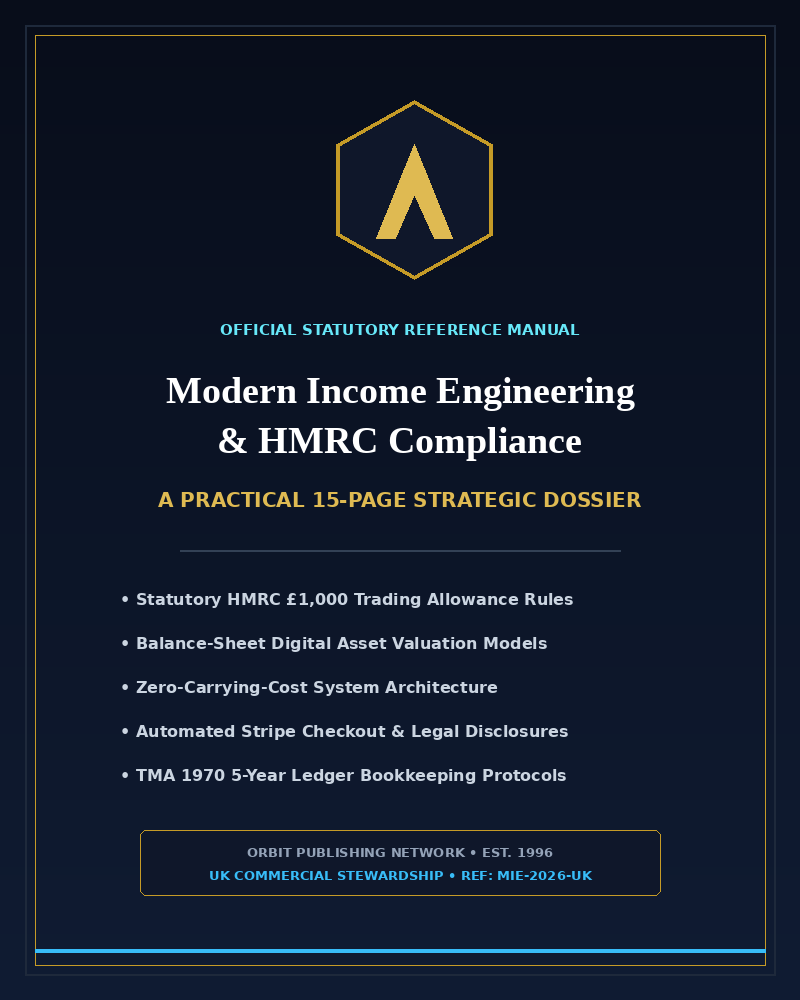
The Modern Income Engineering & HMRC Compliance Manual
A comprehensive 15-page dossier covering balance-sheet asset valuation protocols, step-by-step HMRC £1,000 allowance filing rules, automated Stripe checkout setup, and UK ASA/CMA affiliate disclosures.
IV. Statutory Compliance & Regulatory Precedents
All asset capitalisation frameworks adhere strictly to UK statutory legislation.
HM Revenue & Customs Precedent: Digital assets operated within the UK are governed by the Income Tax (Trading and Other Income) Act 2005 (ITTOIA 2005 s.23FA), providing an automatic £1,000 annual exemption for side activities. Record keeping for assets advancing beyond this threshold is mandated by the Taxes Management Act 1970 (TMA 1970 s.12B) for a minimum period of 5 years.
Commercial Transparency Precedent: All affiliate monetization deployed across digital property assets must comply with Advertising Standards Authority (ASA) CAP Code rules and Competition and Markets Authority (CMA) guidelines requiring prominent upfront identification of commercial partnerships.