
HMRC Statutory Compliance & Corporate Structuring
A clear guide to the UK £1,000 Trading Allowance, HMRC registration triggers, Sole Trader vs. Limited Company asset protection, and UK GDPR rules.
Following the Rules Gives You Freedom: Running an online side income in the UK does not have to be stressful. You do not operate in a legal grey area. UK law has clear rules designed to let you test and build a digital business without dealing with unnecessary paperwork right away.
By using the statutory £1,000 HMRC Trading Allowance, you can build and test your digital assets with zero tax liability and no need to register. As your income grows past £1,000, clear step-by-step rules guide your transition to a Sole Trader or Limited Company smoothly.
I. The Four Pillars of UK Side-Income Law
The four main UK legal rules that govern digital income, tax filings, and privacy.
The £1,000 Trading Allowance
Under ITTOIA 2005 s.23FA, you can earn up to £1,000 gross each tax year completely tax-free. If your total online earnings stay under £1,000, you do not need to register with HMRC or fill out a tax return.
Paperwork: None required under £1,000 per tax year.
TMA 1970 Record Keeping
Under Taxes Management Act 1970 s.7 & s.12B, if your gross earnings go over £1,000, you must register with HMRC by 5 October following the end of that tax year and keep your bookkeeping records for 5 years.
Storage: Keep records safely for 5 full years.
Companies Act 2006 (LTD)
When your net annual profit passes £15,000 to £20,000, setting up a private limited company (LTD) separates your business risks from your personal home and savings, while keeping your home address off public registers.
Privacy: Protects your private home address.
UK GDPR & PECR Rules
Collecting email addresses and using cookies requires clear, honest consent under UK GDPR. If you use affiliate links, Advertising Standards Authority (ASA) rules require a clear disclaimer at the top of the page.
Affiliate Links: Clear commercial disclosure above the first link.
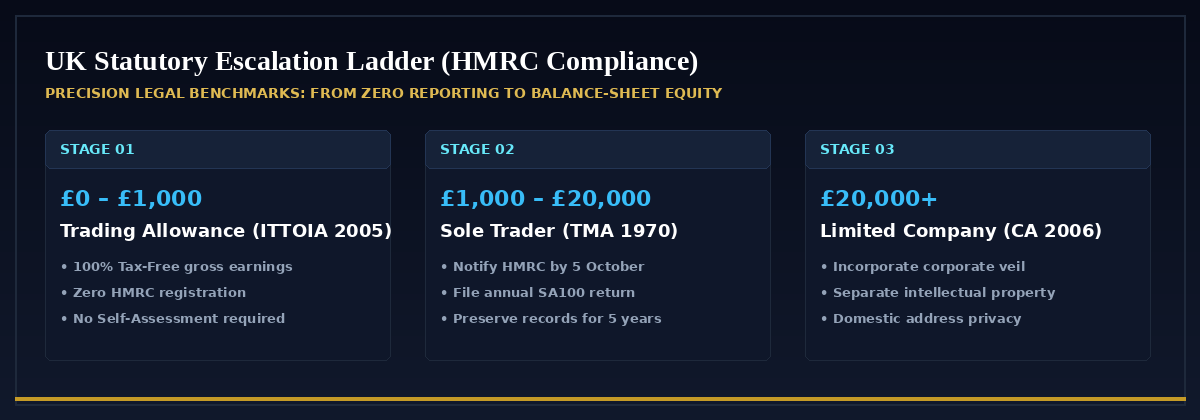
The Clear Escalation Path
By stepping through each stage as your earnings grow (£0 to £1,000 → Sole Trader → Limited Company), you avoid unexpected tax bills and penalties.
II. Sole Trader vs. Limited Company (LTD)
A straightforward comparison of costs, paperwork, and personal protection for UK digital assets.
| Comparison Point | Sole Trader (Self-Employed) | Private Limited Company (LTD) |
|---|---|---|
| Setup Cost & Speed | Free; register online in minutes via Government Gateway | £50 Companies House fee; memorandum & articles |
| Annual Paperwork | Simple (One annual Self Assessment tax return) | Moderate (Annual Accounts, Confirmation Statement, Corporation Tax) |
| Personal Liability Protection | None (You are personally responsible for debts) | Full (The company is a separate legal entity) |
| Home Address Privacy | Private on tax returns; shared on invoices | Public on Companies House unless using a registered office service |
| When to Choose This | Best for earnings between £1,000 and £20,000 per year | Best when profits exceed £20,000+ per year |
III. The 3-Step Compliance Checklist
Three simple things to have in place before placing links or accepting orders.
Affiliate Notice
Place this note above your links: "This site contains affiliate links. If you buy through these links, we may earn a small commission at no extra cost to you." (ASA CAP Code).
Digital Download Consent
When selling digital downloads via Stripe, include this checkbox: "I consent to immediate download access and acknowledge that I waive my standard 14-day cancellation period." (CCR 2013).
Bookkeeping Ledger
Keep a clean spreadsheet of every payment received and every hosting or domain expense. Save invoices and receipts for 5 years past the tax deadline (TMA 1970).
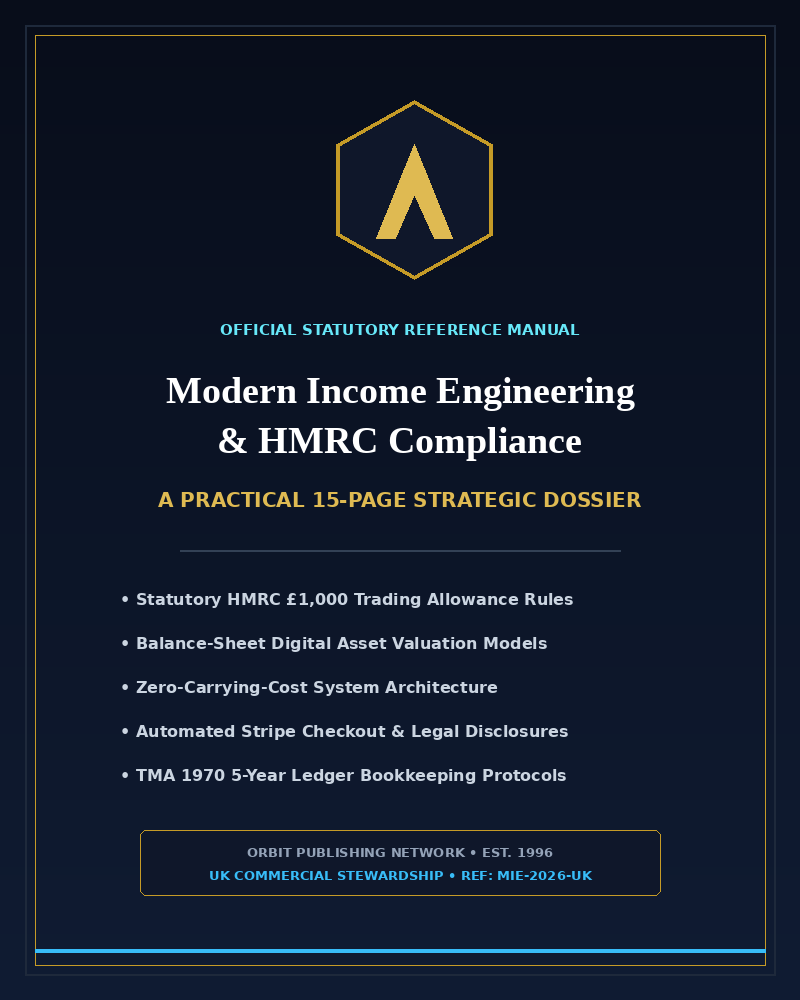
The Modern Income Engineering & HMRC Compliance Manual
A comprehensive 15-page dossier covering balance-sheet asset valuation protocols, step-by-step HMRC £1,000 allowance filing rules, automated Stripe checkout setup, and UK ASA/CMA affiliate disclosures.
IV. Official UK Legal Precedents
Exact statutory anchors supporting our guides.
Income Tax (Trading and Other Income) Act 2005 (ITTOIA 2005 s.23FA): Authoritative UK legislation granting complete tax exemption on gross trading receipts up to £1,000 per tax year.
Taxes Management Act 1970 (TMA 1970 s.7 & s.12B): Explicit statutory law governing the legal duty to notify HMRC when trading exceeds allowance limits, and setting the 5-year record-keeping rule.
Data Protection Act 2018 & UK GDPR: Mandatory UK rules governing legal consent for email newsletters, privacy policies, and visitor data rights.